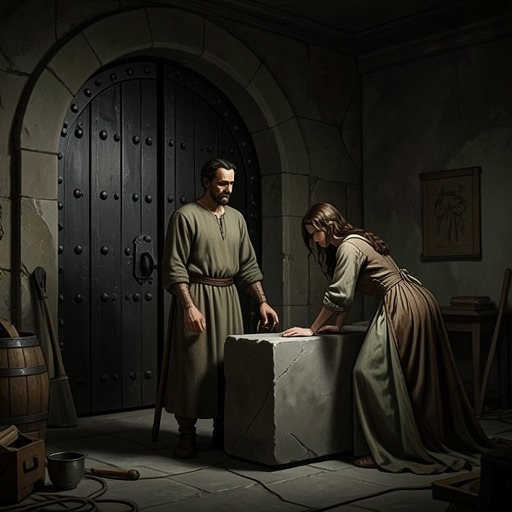
Idumbankaari
Ponniyin SelvanIdumbankaari is a conspirator disguised as a servant at Kadambur Palace, where his quiet management of a hidden underground entrance helps conceal the movement of Mandhiravadhi and his companions. His scenes turn on the tension between precise control and sudden exposure: he can make the passage disappear, but a stuffed monkey dropped into it forces him to perform an explanation before the very people he has been helping to conceal.
Identity and Position
Idumbankaari is identified as one of Mandhiravadhi’s cohorts and as a man masquerading as a Kadambur Palace servant. The disguise places him inside the palace’s ordinary routines while giving him access to its concealed routes. The evidence does not establish his broader history or rank among the conspirators; it shows him at work, sustaining the secret passage operation and maintaining the appearance of an employee occupied with his duties.
His role is revealed through the passage rather than through an introduction in a public setting. When he emerges from an underground pit near the shrine, two hidden observers recognize him. The opening has been concealed beneath displaced elephant and horse figures, so his appearance exposes both his identity and the hidden mechanism. He leaves the opening accessible, then goes purposefully to the Ayyanaar Shrine near Kadambur and lights lamps inside. The lamps and the open pit make the shrine a working point in a clandestine route, not merely a place the conspirators happen to pass.
Operating the Hidden Entrance
Idumbankaari’s work depends on controlling when the passage is open. After Vandhiyathevan descends into it, Idumbankaari returns from the shrine and notices the exposed opening. He takes the spear fixed in the ground beside the altar and twists it hard. The elephant and horse figures move back into place, and the pit closes as though it had never existed. A single concealed mechanism thus restores the ordinary appearance of the shrine and hides the conspirators’ route from anyone arriving afterward.
The operation is not simply mechanical: Idumbankaari also monitors the space above the passage. When Manimekalai enters with a lamp, he quickly closes the secret door and turns to the nearby tiger, removing his turban and dusting the animal with an air of industrious routine. The sudden change from secretive passage-keeper to palace servant is the point of the performance. Manimekalai sees a servant apparently cleaning; she does not witness the entrance he has just concealed. He greets her with elaborate surprise and asks what brings her there, while she recognizes him and asks why he is there himself.
After Manimekalai leaves and the secret door closes, Idumbankaari presses his ear against the elephant’s face, listening until he is sure nothing can be heard from the adjoining room. He then opens the underground entrance, descends only as far as his waist, and waits. The two men exchange owl calls, after which the muted sound of many feet approaches through the passage. His actions show him regulating both access and sound: he listens, signals, and holds the entrance ready for the group’s arrival.
Exposure and Improvisation
The passage operation is disrupted when Vandhiyathevan uses the stuffed monkey displayed in the chamber to obstruct the entrance. As the conspirators approach, Idumbankaari hears commotion and asks whether danger requires them to turn back. Idumbankaari answers with studied nonchalance: he claims that the stuffed animal fell onto his head as he opened the secret door and startled him. He then points to the monkey as the immediate problem, explaining that it blocks the way and will neither slide down nor push up, and asks the others to wait while he finds a way to remove it.
The explanation is a piece of quick cover, not evidence that Idumbankaari understands how the obstacle arrived. Vandhiyathevan has pushed the monkey onto him while he is on the passage steps, preventing him from identifying the assailant, then thrust the monkey headfirst down the opening and shifted a crocodile figure. Idumbankaari can describe the obstruction, but not its source. His account turns an apparent threat into an inconvenient accident and buys him time to deal with a passage that has ceased to work as intended.
Narrative Role
Idumbankaari’s episodes make the hidden route tangible through small, exact actions: the spear twist that closes the entrance, the ear held to the wall, the waist-deep wait on the stairs, the answering owl call, and the improvised complaint about the stuffed monkey. These details establish how the conspirators’ secrecy is maintained in practice, through mechanisms and watchfulness as much as through disguise.
They also show the limit of that control. Idumbankaari successfully restores the entrance after Vandhiyathevan enters and conceals it from Manimekalai, but the same secret space becomes vulnerable when Vandhiyathevan turns its objects against him. The servant’s convincing performance survives the encounter; the conspiracy’s passage, however, is no longer under his sole command. His importance lies in this narrow but consequential function: he makes concealment work, then has to improvise when another observer has learned to use the hidden machinery against him.